Review from Diego Salcedo
Straight answer on the phone about what it would involve, no vague runaround, and the price at the end matched. Screens sit flush and slide without catching now.
Get a Free Quote in 5 Minutes
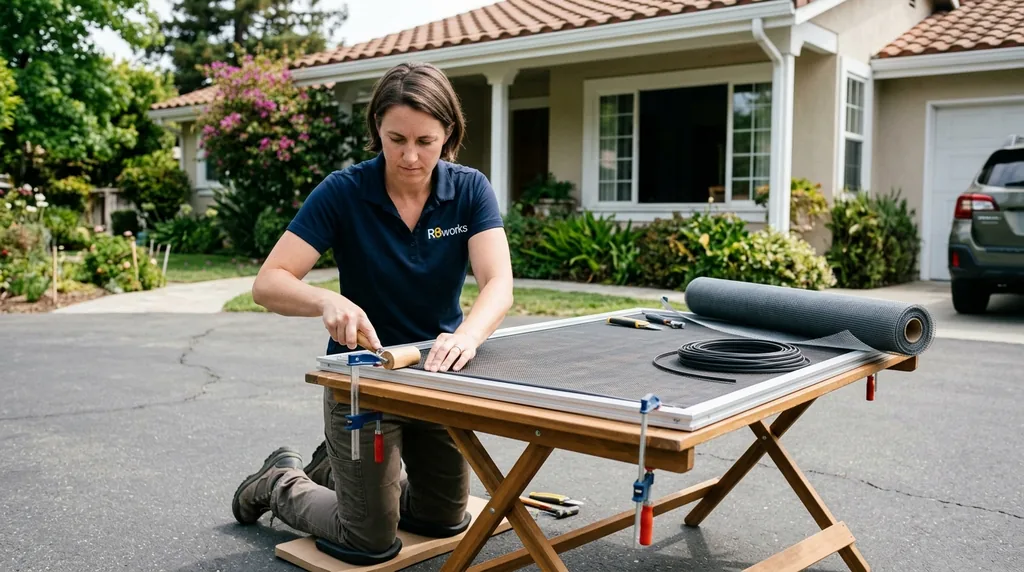
Spline comes in half a dozen diameters and the frame decides which one fits. Too thin and the first windy afternoon lifts the mesh out of the channel; too thick and it bows the long sides inward. We carry the range and match it to the groove instead of using whatever is on the truck.
The plastic keys joining an old aluminum frame go brittle long before the mesh does. Re-screening a frame whose corners have crumbled buys you a few weeks — the frame racks out of square and lets go again. We replace the keys, or rebuild the frame, before anything gets rolled.
A solar screen works by stopping heat before it touches the glass, and that needs an air gap between fabric and pane. Fitted the wrong way round it sits flush and gives back most of what you paid for. Ours go on facing out, on the exterior, where the fabric can shed the heat it absorbs.
A screen is sized to its own frame, outside edge to outside edge, and a sixteenth of an inch either way is the difference between one that drops into the channel and one you have to force. We measure what is in our hands, not the hole it came out of.
Complete transparency on what our service covers.
Four steps, and you can stop after any of them.
A few questions online. No phone call, no credit card, nothing to sign.
about 2 minutesWe read your answers and photos, then text you a firm figure — not an estimate to be revised on the day.
within 5 minutesSame day is often available. You are not committed to anything until you choose one.
you decideThey arrive with the right tools, do the work, and clear up before they leave.
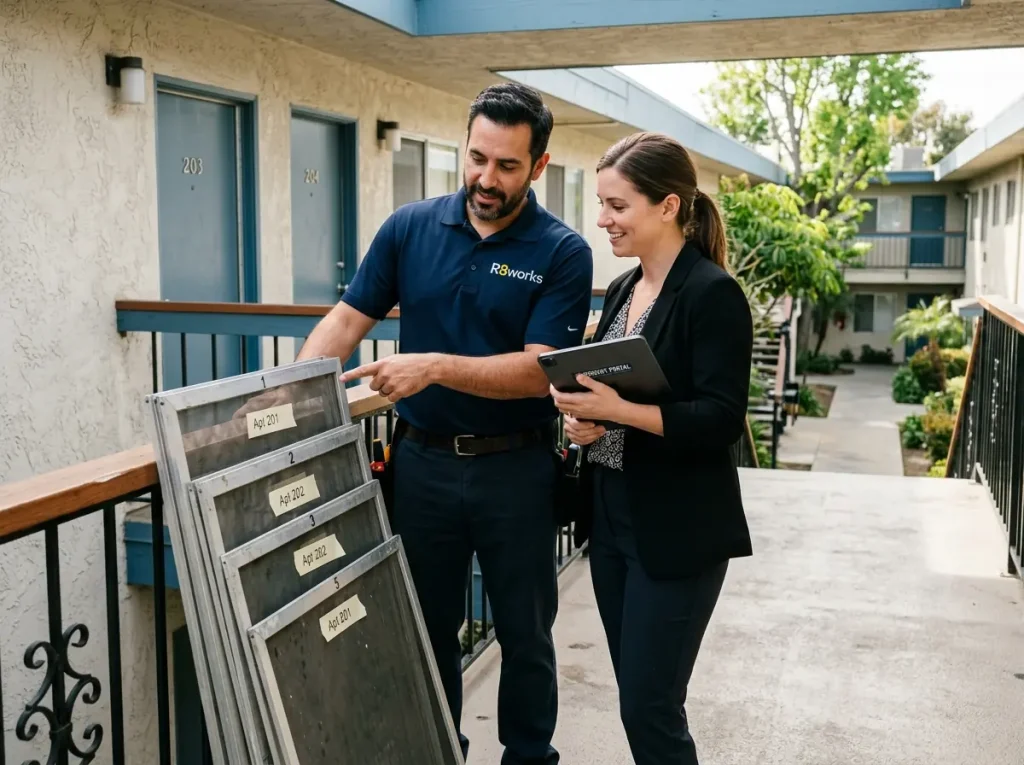
the price you agreedScreens are a turnover item. A tenant moves out, the walkthrough finds two panels pushed out and one with a cat-sized hole, and someone has to deal with it before the unit shows again. We work with property managers, HOA boards and short-term rental operators on exactly that: panels pulled and labeled by unit, rescreened in one pass, and back in their openings before the next viewing. Rates are set per panel across a building rather than per call-out, the schedule is booked against the property instead of the individual unit, and everything lands on one account. Pet-resistant fabric on the units that need it and standard fiberglass everywhere else is the usual arrangement, and it keeps the recurring damage down without re-fabricating the whole building.
Almost every screen that reaches us has one of three problems, and they take three different answers. The screen mesh has torn or gone soft and baggy, which is a rescreen and the frame goes back the way it came. The frame has racked out of square or a corner has let go, which no amount of new mesh will fix. Or both are fine and the panel simply will not stay in the window, because a spring plunger, a clip or a pull tab has broken. Working out which one you have, before anything is cut, is most of the job.
Spline is the flexible cord that traps the mesh in the groove around the frame, and it is sold in a range of diameters in small steps. The frame decides which one belongs in it. Under-sized for the channel, it holds until the first real wind and then the mesh lifts out along one edge. Over-sized, it goes in hard and pulls the two long sides of the frame inward, and a panel that used to drop into its track now has to be forced. Nothing about the frame tells you this by eye: the old spline gets measured, or a test length gets rolled into one corner and checked before the rest follows.
Tension is the other half. The mesh goes in with the frame supported so it cannot bow, and the corners are checked square before the last side is rolled. A screen rolled too tight looks perfect on the bench and will not sit in the opening.
Standard fiberglass is what most windows already have — an 18 by 16 weave of vinyl-coated glass yarn, soft, inexpensive and easy to see through. It is also what a determined cat gets through in one afternoon. Pet-resistant screen mesh is a vinyl-coated polyester several times heavier; it survives claws, and it is noticeably more visible from the street. Solar screen fabric is denser again and is doing a different job altogether: it stops a large share of the sun's heat before it ever reaches the glass, which is why it belongs on the outside of the window with an air gap behind it. The Department of Energy's guidance on shading and solar control puts exterior shading ahead of anything fitted on the inside for exactly that reason. Solar fabric also darkens the room, which is welcome in a west-facing bedroom and rarely welcome in a kitchen. It takes the edge off the heat rather than cooling anything, so if that bedroom has to actually come down in temperature that is window AC installation, and if the glare is the real complaint the answer sits on the inside with curtain and blind installation.
Roll-formed aluminum frames from mid-century sliders are held together at the corners by plastic keys, and those go brittle decades before the mesh does; on those, the corners get checked and replaced before anything is rolled. Vinyl windows from the nineties onward usually carry the screen in an integral track with spring plungers or finger pulls, where a broken plunger is a hardware fix and not a rescreen at all. Older houses here often have wood-framed screens with no spline in them — the mesh is stapled and hidden under a thin molding, which is slower to do properly and worth keeping rather than swapping for aluminum.
One panel — measured, stripped, re-meshed and refitted — runs about fifteen to thirty minutes once the right spline and fabric are in hand. A whole house of eight or ten screens is a morning. The part that takes longer than people expect is not the rolling; it is getting every panel out, labeled to the window it came from, and back into the right opening afterwards. Screens from the same wall are rarely the same size, and two of them swapped is a job that has to be done twice.
Straight answer on the phone about what it would involve, no vague runaround, and the price at the end matched. Screens sit flush and slide without catching now.
Nine screens that had been sitting in the garage since we moved in, all of them shot. They rescreened the eight worth saving and built one new frame. Now the house actually gets a breeze through it, which after four years is a novelty.
Casement windows, so the screens clip on the inside and two of the clips were broken. They replaced those and rescreened five panels. One frame had a bend they could not get out and they told me it needed rebuilding rather than just rolling new mesh into something that would fail again. I appreciated being told rather than finding out next spring.
Been putting this off for three years. Took them ninety minutes. Feel a bit silly.
Allergy season is why I bothered. Finer mesh on the bedroom windows so we can sleep with them open. It does cut the airflow a bit, which they warned me about, but it is a trade I would make again.
