TV/Media Wall Installation
Get a Free Quote in 5 Minutes
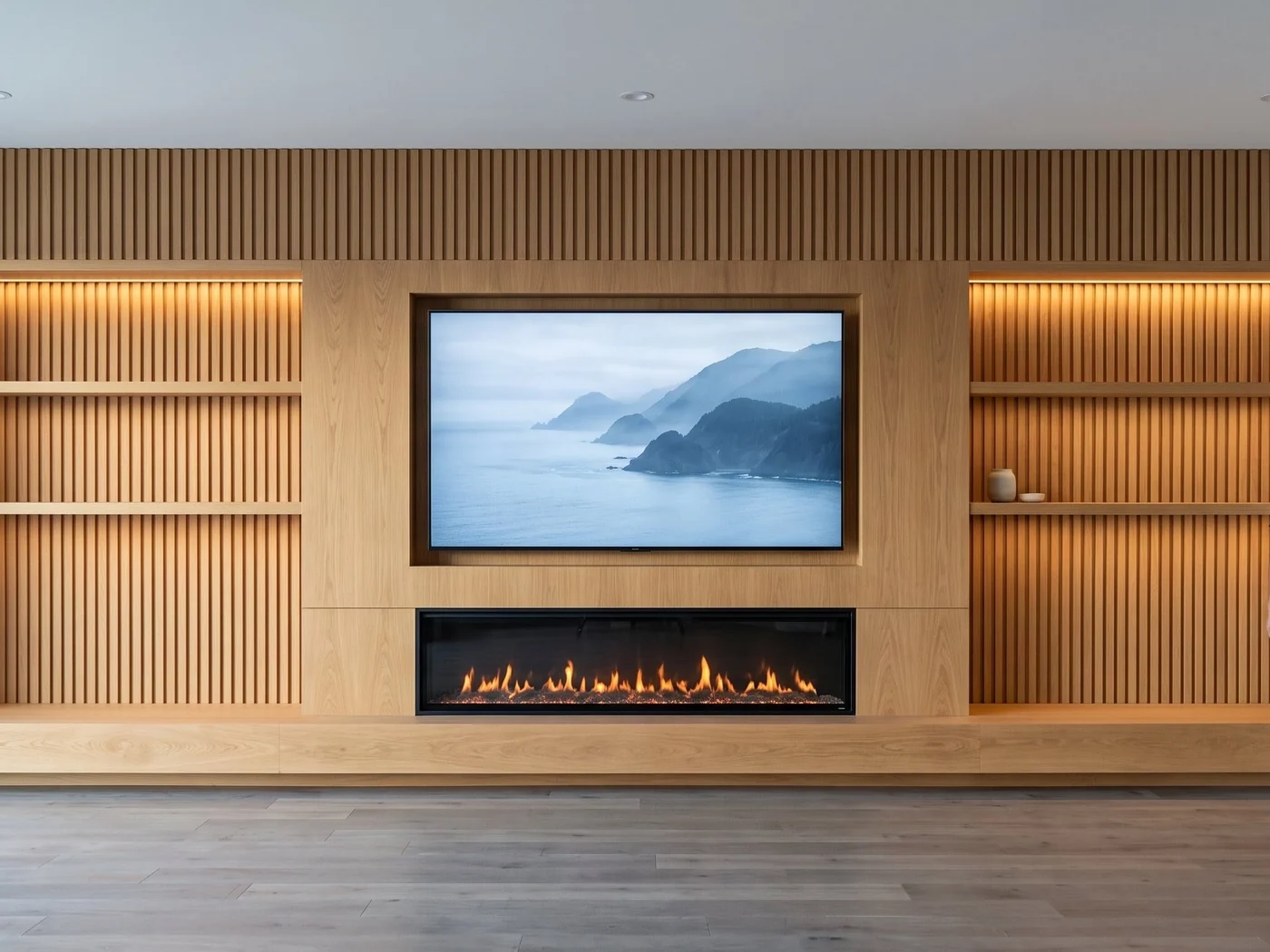
Why hire us?
Heat Gets Somewhere To Go
A TV boxed into a sealed cavity cooks itself and voids the warranty. We build in a vented chase above the set - and keep the required clearance when a fireplace sits below it.
Backing Behind the Mount
Studs almost never line up with the centre of your TV. We add solid blocking across the framing first, so the bracket lands on wood instead of drywall anchors.
Cables That Still Reach
A stiff HDMI pressed against a back panel bends, loosens, and drops signal months later. We leave real depth behind the screen and use low-profile connectors and in-wall rated cable.
Power Done to Code
Running an extension cord inside a wall is a code violation, not a shortcut. We fit a recessed power kit and keep line voltage separated from your low-voltage runs.
Services Included & Excluded
Complete transparency on what our service covers.
✓ Included
- On-site measure and design layout before any build
- Framing the wall or false wall (wood or metal stud)
- Solid blocking behind the mount location
- Vented chase above the screen so heat escapes
- In-wall rated cable routing for HDMI, network and speakers
- Recessed power kit and in-wall receptacle
- Drywall, tape, and finish ready for paint
- Mounting the TV, soundbar and shelving
- Cable dressing and device testing
- Full debris removal and cleanup
✕ Excluded
- × Painting or wallpapering the finished wall (Add-on)
- × Stone, tile or slat wall cladding (Add-on)
- × Electric fireplace insert - supply and fit (Add-on)
- × Floating shelves and millwork in hardwood (Add-on)
- × Supplying the TV, soundbar or AV equipment
- × New circuits, sub-panels or breaker work - licensed electrician required
- × Moving gas lines or venting for a gas fireplace
- × Structural changes to a load-bearing wall - requires permit and engineer
- × Asbestos or lead paint remediation in older homes
How it works
Four steps, and you can stop after any of them.
-
1
Tell us about the job
A few questions online. No phone call, no credit card, nothing to sign.
about 2 minutes -
2
Get your exact price
We read your answers and photos, then text you a firm figure — not an estimate to be revised on the day.
within 5 minutes -
3
Pick a time that suits you
Same day is often available. You are not committed to anything until you choose one.
you decide -
4
A vetted pro handles your TV/Media Wall Installation
They arrive with the right tools, do the work, and clear up before they leave.
the price you agreed
Media Wall Installation Partner Program
Do you design, sell, or build custom media walls but not install them? R8Works works behind the scenes for interior designers, cabinet and millwork shops, AV integrators, and remodeling contractors across California. We read your shop drawings, coordinate blocking, wiring and the fireplace rough-in before the wall closes up, and finish the installation to your specification - under your brand, on your schedule. You keep the client relationship; we make sure the wall goes in right the first time.
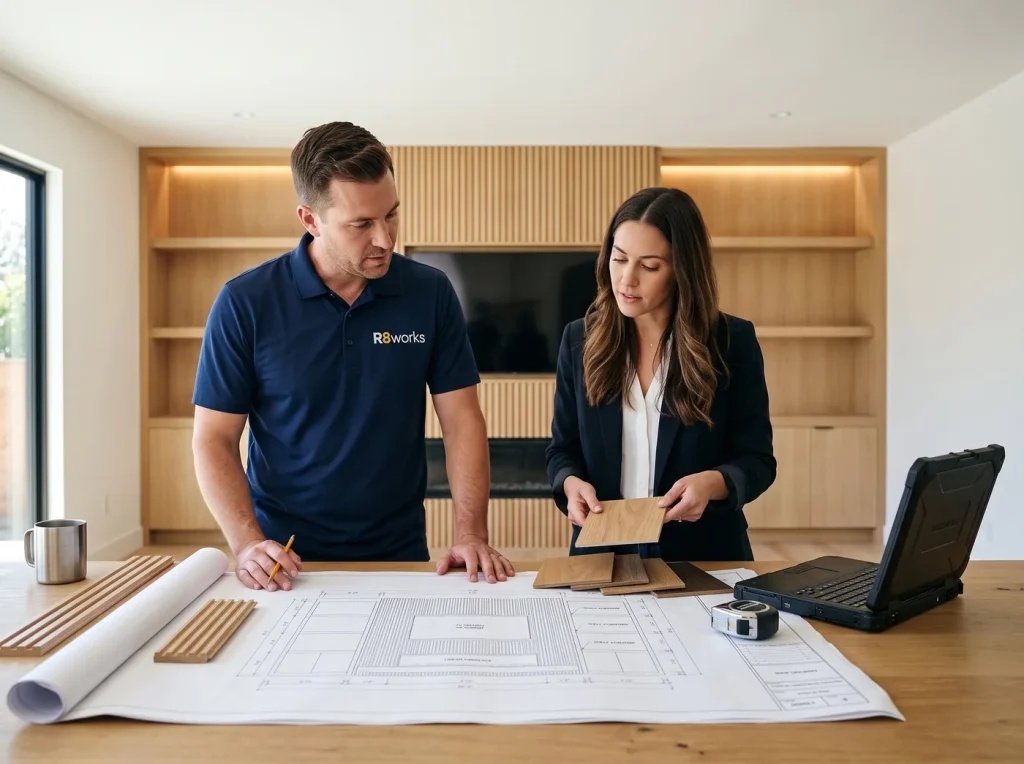
How a Media Wall Actually Gets Built
A media wall — also called a media center, feature wall, accent wall or built-in entertainment center depending on who you ask — is carpentry first and AV second. The television is the last thing that happens. Everything that makes it look effortless happens inside the wall, weeks of complaints later if it is done wrong.
If your wall is already finished and all you need is the screen up safely and the cables gone, that is TV mounting — a smaller job, and we would rather point you at it than sell you a build you do not need.
Framing: the part that decides everything after it
Two approaches. If the existing wall is sound and you only need depth for cables and a recessed screen, we open it, add blocking, and close it back up. If you want a flush fireplace, deep shelving, or a screen that sits proud of the room, we build a false wall in front of the existing one — typically 4 to 8 inches deep, framed at 16 inches on centre.
The tolerance that matters is plumb across the full width. A wall that is a quarter inch out over eight feet looks fine to the eye while it is bare, and looks visibly wrong the moment a straight black rectangle is hung on it. We shim the framing to the floor and ceiling, not to the old wall, because the old wall is rarely straight.
Behind the mount location we run solid horizontal blocking across at least three studs. Studs almost never land where the centre of a 65 to 85 inch screen wants to be, and a bracket carried by drywall anchors is a bracket that will move.
Heat: the failure nobody warns you about
A screen recessed into a sealed cavity has nowhere to send its own heat. Above an electric fireplace it is worse: warm air rises straight into the recess and sits there. Manufacturers are specific about this, and most warranties exclude heat damage.
The fix is not complicated, it is just extra work. We leave a vented chase above the screen, keep the clearance the fireplace insert's own manual specifies, and where the recess is tight we fit a low-noise cavity fan. If a competitor quotes a recessed TV over a fireplace without mentioning any of this, they have not built many.
Glare is the other half of the same problem. A large screen facing a west window turns into a mirror by late afternoon, which is why a good number of these builds get paired with motorized shades on the same visit.
Cable and power, done so it still works in three years
- Depth behind the screen. A stiff HDMI pressed flat against a back panel bends past its radius, works loose, and starts dropping signal months later. We leave real clearance and use low-profile or right-angle connectors.
- In-wall rated cable only. CL2 or CL3 jacketed runs for HDMI, network and speakers. Standard patch cable is not rated to sit inside a wall.
- Power is not an extension cord. Running one inside a wall is a code violation rather than a shortcut — see NFPA electrical safety guidance, from the body that publishes the National Electrical Code. We fit a UL listed recessed power kit so the receptacle sits behind the screen and the run inside the wall is rated for it.
- Separation. Line voltage and low voltage are kept apart inside the cavity — parallel runs induce noise you will hear through the soundbar.
An open wall is the easiest moment to pull any other low-voltage cable you are likely to want later. If security cameras or extra network drops have been on the list, say so before we close it up rather than after.
What changes with the house
Bay Area housing stock is unusually varied, and the wall behind your TV is rarely the one the tutorial assumed.
- Pre-war and Victorian. Lath and plaster, not drywall. It cracks if you cut it carelessly, and the stud spacing is often irregular. A false wall is usually cleaner than opening the original.
- Eichler and mid-century post-and-beam. Exposed structure, thin infill panels, and often no attic to run anything through. Depth has to be built forward, and the ceiling is rarely available as a cable path.
- Condos and towers. Concrete or shear walls that cannot be cut, plus HOA rules on penetrations and on anything shared. A freestanding or shallow false wall solves what a recess cannot.
- Newer tract construction. The easiest case — standard framing, predictable spacing, and usually room in the cavity for everything.
Which category the work falls into also decides whether a permit is involved. A non-structural false wall generally is not; altering anything load bearing is. The rules that govern both are published by the state in the California Building Standards Code, and we tell you which side of that line your job sits on during the measure.
How long it takes
A straightforward false wall with cable management is a one day build plus a return for finish. Add a fireplace insert, deep shelving, or a wall that needs opening and repairing, and it becomes two to three days spread across the drywall and paint cure. Anyone quoting a full media wall as a same-day job is quoting a TV mount with extra steps.
